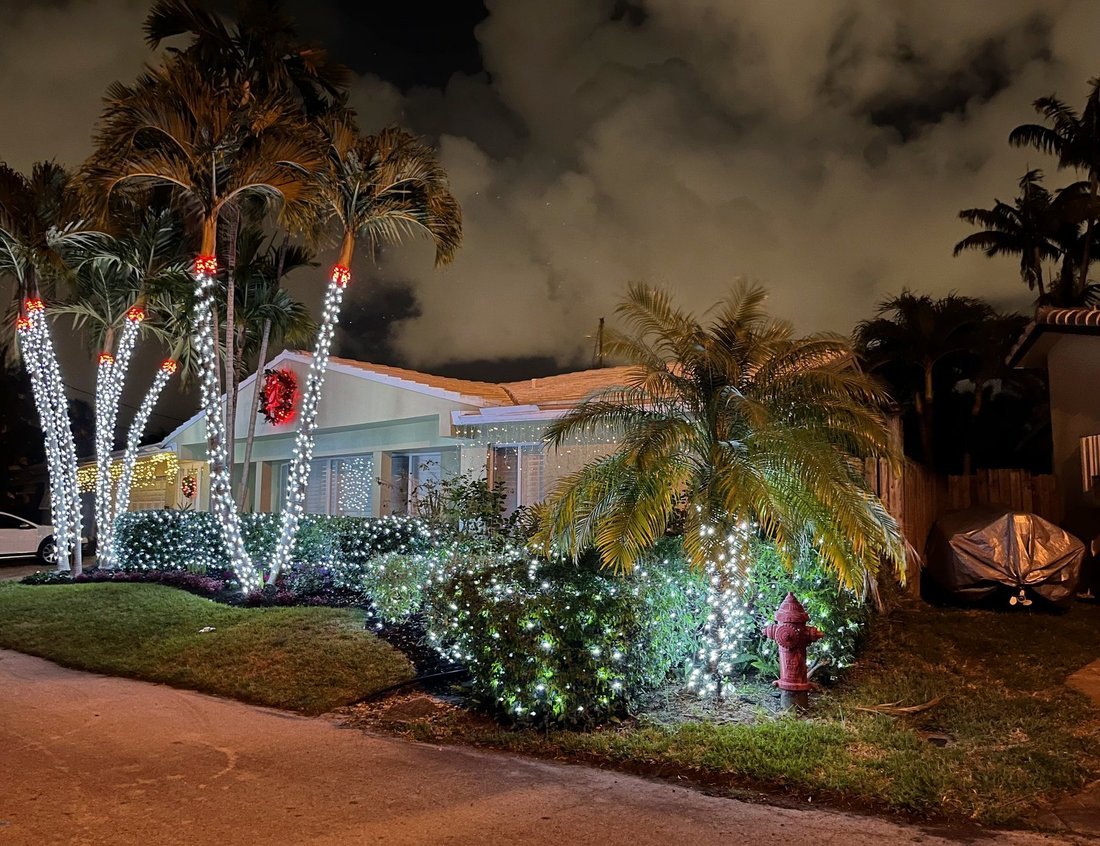
Davis Islands is the most architecturally specific place we work in Tampa. Christmas lights Davis Islands means 1920s Mediterranean revival, barrel tile, arched loggias and stucco parapets — and a roofline that was built for shade, not for clips.
(727) 342-0248
The islands were dredged and platted in the 1920s and developed fast, which left an unusually consistent architectural record — Mediterranean revival stucco, low-pitch tile roofs, arched openings and courtyard entries, much of it still original.
Golf carts are the preferred way to get around and there are no traffic lights on the islands. People move slowly and look at things.
Waterfront lots carry private docks and views across Hillsborough Bay to the downtown skyline, and those houses are seen from the water as often as from the street.
Barrel tile does not take a standard clip. Mounting to tile without cracking it or drilling into it takes the right hardware and a slower hand, and it is the single biggest difference between a professional Davis Islands install and a damaged roof in January.
The arches are the signature of these houses. Following an arched loggia or entry with light that actually traces the curve reads as designed; running a straight line across the top of it reads as a shortcut.
Stucco parapets and flat-ish rooflines mean there is often no eave to work from at all, and the lighting has to come from the wall plane or the landscape instead.
Yes. Tile takes specific mounting hardware and a careful hand, and it is assessed before install rather than improvised on the roof.
Those are usually the best feature on the house and worth doing properly. Tracing a curve takes longer than a straight run and looks like it.
Yes. On Davis Islands the water side is seen constantly and leaving it dark is a missed opportunity.
It is part of the planning. People here see displays at close range and slow speed.
These houses reward doing it properly. We walk the architecture before we design anything.
(727) 342-0248